Most of The Grid is filled now. We've looked at the recurring Crisis periods that are often the most obvious part of history classes, the Awakenings halfway between them, and the Highs as one becomes the next. Or, as they are referred to now, the Fourth, Second, and First Turnings, respectively.
This leaves the Third Turning, also known as the Unraveling, a period that is often conspicuously ignored when history is discussed. This is in large part because it's the low point of organizational power. Governments aren't able to do as much. Individuals, on the other hand, can.
Wikipedia has a page for Annus Miribilus - Year of Miracles/Wonders, years where multiple significant events happened. Most of them are directly associated with individuals, and most of those occur in Third Turnings.
Looking at the exceptional activities of individuals - activities that are often remembered for just this reason - can give a better feel for these Turnings than trying to comprehend what governments are up to.
Sunday, November 30, 2014


Saturday, November 29, 2014
1714
First - 1714 - The Longitude Prize is offered by the English Parliament
The prizes - the equivalent of millions of dollars today - were a significant investment not only in keeping ships safe, but also in allowing them to move quickly to their destinations. This made additional exploration possible and also improved the ability of Britain to trade with her colonies.
The great age of navigation started in the early 15th century, when Portugal's Prince Henry "the Navigator" began explorations into the Atlantic and south along Africa, using instruments such as the compass and cross-staff. One of its most visible success stories was the (European) discovery of the American continents. In the 200 years following, colonies were set up by any countries that could manage the voyages required, and ships regularly sailed between Europe and the Americas.
Nonetheless, navigation tools were still rudimentary. Identifying how far north or south of the equator a ship was could be done by measuring how far above the horizon an astronomical object was. At the North Pole, for example, the North Star should be directly overhead. As one sails south, it would dip further and further down, until at the equator it would be at the horizon. In practice, measuring how the sun changed was used for this straightforward calculation. It had long been possible to make this determination, allowing ships at sea to easily determine their latitude. However determining longitude - how far east or west had been sailed - was not nearly as simple. There was no effective method to do it accurately and effectively.
The lack of a method was seen as a definite problem when four British warships were lost in 1707 near the isles of Scilly. The loss of 1400 lives off the southwest coast of Great Britain, because the sailors were uncertain about the location of their ships, led to concern about how to prevent it from happening again. (That the problem may have been in calculating latitude, not longitude, didn't change the perception of the issue.) There had been many proposals for how best to do so, many of which used astronomical observations, as latitude calculations did. Any of them might be useful, with enough additional work spent to refine them. How could the optimal plan be identified?
In 1714, the method chosen was the Longitude Prize, which was created upon the passage of the Longitude Act. The goal of the prize was to find an effective method for measuring longitude. The smallest price, for £10,000 pounds sterling, required accurate measurements within only 60 nautical miles; the largest would need to be twice as accurate, within 30 nautical miles. The prize was eventually awarded to John Harrison, who approached the problem as one of timekeeping rather than observation. He showed that a sufficiently accurate timepiece (chronometer) could be manufactured, yielding a consistent fixed time that could be compared to a ship's time based on local noon (i.e. when the sun was highest in the sky). The difference in time could be converted to distance from the locale represented by the chronometer.
The prizes - the equivalent of millions of dollars today - were a significant investment not only in keeping ships safe, but also in allowing them to move quickly to their destinations. This made additional exploration possible and also improved the ability of Britain to trade with her colonies.
Friday, November 28, 2014
Awakens
The name of the latest Star Wars movie is The Force Awakens. Which is to say, it includes a cognate of Awakening.
Which probably wouldn't have mattered much except for a recent meme about Mark Hamill (Boomer, 1951), who is now 63 - as old as Alec Guinness (G.I., 1914) was when the original Star Wars movie was released. As a member of a Prophet archetype generation, it makes even more sense for him to take on a role like that of Obi-Wan Kenobi, i.e. the old and wise mentor to the new Hero.
In Generations, the original movie is mentioned as an example of the generational breakdown that is common in Hero stories: Young adult Hero (Luke, plus of course Leia), slightly older practical scoundrel Nomad (Han Solo), and wise elder mentor Prophet (Obi-Wan). The further implication of this grouping is that it's a Crisis period, that being how the generations show up in a Fourth Turning. The apocalyptic expectations of the first movie, with a planet-destroying weapon under the control of leaders willing to use it, supports this interpretation.
While this view is weakened by the first two sequels, it's the prequels that show a real Crisis war enveloping the galaxy. There are multiple hostile combatant groups, involved with massive armies and no clear view of how it can end up well - and, indeed, the resolution isn't in favor of the good guys. The focus is on Anakin/Vader, the villain of the series - so quite possibly a Nomad archetype, himself. The idea that the minor skirmishes of Yavin, Hoth, and Endor are the "real" Crisis doesn't stand up in comparison with these massive conflagrations. With that in mind, Empire and Jedi appear as Second Turning, not the Fourth, with the spiritual Force returning to prominence after being nearly extinguished by Palpatine. Luke goes from hotshot Hero, succeeding through the sacrifice of Kenobi, to warrior-priest Prophet, prevailing over the Emperor through sheer moral superiority.
Which brings us to this trailer and the upcoming film, which has the potential either to move the cycles around again, or to confirm one interpretation over the other. As it is including the original characters played by the original actors, it's presumably going to be set about forty years after the Rebellion's success. If Endor was the peak of the Awakening, we would now be back into a Crisis; if a Crisis, we would be in Awakening again.
If The Force Awakens is a Second Turning story - as suggested by the title and the first movie - it would likely involve a spiritual component, which could be expected to involve the "awakening" Force. Perhaps someone has rejected the vanilla goody-goody Jedi way that Luke has been teaching. No doubt Luke accepts only the purest form of Yoda's lessons, having experienced firsthand the potential dangers of a more open interpretation. Naturally, an apostate breeds followers, although they would be limited by the rarity of Force-sensitivity. The protagonists may be taking on a smaller (and therefore individually more powerful) enemy group, and deciding through their actions the direction of the Republic going forward.
The existing movies, on the other hand, mostly indicate that this should represent a Fourth Turning. If so, the time since the Rebellion's success has been one of uncertainty, perhaps even chaos. The Force-sensitive, lacking any guidance for a generation after the Palpatine's original success, may be a different sort of threat, a critical mass of proto-Vaders attempting to use their powers based on what they can teach themselves. Enough time has passed for a counter-rebellion to be in the planning stages, so that the former Rebels have to prepare, already, to defend what little they have managed to pull back together. The combatants on either side, as in the prequels, are likely to be large armies involved in massive battles.
That's the prediction, anyway, all written before viewing the trailer, shown below:
And: The fourth word spoken in the trailer is "Awakening." There are specific references to the Light and the Dark sides. A non-clone in a stormtrooper uniform appears to be having an internal struggle. The battles shown are smaller, not apocalyptic.
Looks like a Second Turning story.
Which probably wouldn't have mattered much except for a recent meme about Mark Hamill (Boomer, 1951), who is now 63 - as old as Alec Guinness (G.I., 1914) was when the original Star Wars movie was released. As a member of a Prophet archetype generation, it makes even more sense for him to take on a role like that of Obi-Wan Kenobi, i.e. the old and wise mentor to the new Hero.
In Generations, the original movie is mentioned as an example of the generational breakdown that is common in Hero stories: Young adult Hero (Luke, plus of course Leia), slightly older practical scoundrel Nomad (Han Solo), and wise elder mentor Prophet (Obi-Wan). The further implication of this grouping is that it's a Crisis period, that being how the generations show up in a Fourth Turning. The apocalyptic expectations of the first movie, with a planet-destroying weapon under the control of leaders willing to use it, supports this interpretation.
 |
| Something closer to how a Crisis-era battle would appear. |
Which brings us to this trailer and the upcoming film, which has the potential either to move the cycles around again, or to confirm one interpretation over the other. As it is including the original characters played by the original actors, it's presumably going to be set about forty years after the Rebellion's success. If Endor was the peak of the Awakening, we would now be back into a Crisis; if a Crisis, we would be in Awakening again.
If The Force Awakens is a Second Turning story - as suggested by the title and the first movie - it would likely involve a spiritual component, which could be expected to involve the "awakening" Force. Perhaps someone has rejected the vanilla goody-goody Jedi way that Luke has been teaching. No doubt Luke accepts only the purest form of Yoda's lessons, having experienced firsthand the potential dangers of a more open interpretation. Naturally, an apostate breeds followers, although they would be limited by the rarity of Force-sensitivity. The protagonists may be taking on a smaller (and therefore individually more powerful) enemy group, and deciding through their actions the direction of the Republic going forward.
The existing movies, on the other hand, mostly indicate that this should represent a Fourth Turning. If so, the time since the Rebellion's success has been one of uncertainty, perhaps even chaos. The Force-sensitive, lacking any guidance for a generation after the Palpatine's original success, may be a different sort of threat, a critical mass of proto-Vaders attempting to use their powers based on what they can teach themselves. Enough time has passed for a counter-rebellion to be in the planning stages, so that the former Rebels have to prepare, already, to defend what little they have managed to pull back together. The combatants on either side, as in the prequels, are likely to be large armies involved in massive battles.
That's the prediction, anyway, all written before viewing the trailer, shown below:
And: The fourth word spoken in the trailer is "Awakening." There are specific references to the Light and the Dark sides. A non-clone in a stormtrooper uniform appears to be having an internal struggle. The battles shown are smaller, not apocalyptic.
Looks like a Second Turning story.
Thursday, November 27, 2014
Thanksgiving
The Second Turning after the defeat of the Spanish Armada lasted from 1621 to 1649. Before going with King Charles I Dissolves Parliament (1629), the specific Grid item for that Second Turning was planned as The First Thanksgiving (1621). This seemed a good match for an Awakening period: The Pilgrims headed to the New World for fundamentally religious reasons, they saw their successes as the hand of Providence, and their Thanksgiving feast was a way to acknowledge God's involvement in their lives.
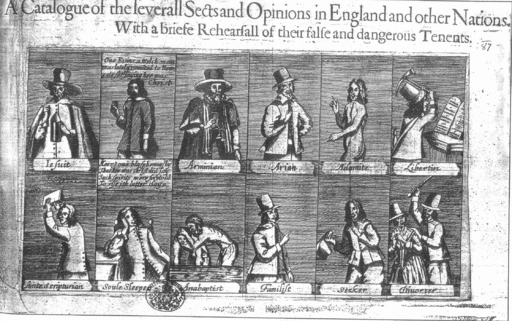 |
| English Dissenters: Just one of the topics that pops up when attempting to identify the historical context of Thanksgiving, and good luck trying to explain how any of them are related. |
Although that’s all true, none of these indicators were strong enough to tie the harvest feast with the local natives to the concept of a Second Turning/Awakening. Or, perhaps it would be better to say, attempting to explain WHY these indicators DID strongly tie the events with the model kept requiring in-depth supporting documentation on disparate items like:
- What the clothes the Pilgrims wore said about them.
- The Vestments Controversy and the rise of Puritanism
- How Calvinism related to Puritanism and Separatism
- Why the Pilgrims were in the Netherlands, and why they thought it necessary to depart when they did (and why that probably does tie usefully to their Turning).
- How the Pilgrims managed to survive despite arriving too late in the season to farm effectively, while surrounded by native tribes who didn't necessarily want them there.
- Why Tisquantum was there when they arrived, and the part he played in their successes.
- To what extent the colonists saw their situation in religious terms.
After a while, it became clear that there wasn’t a clear and concise way to assert that The First Thanksgiving was a memorable example of events in a Second Turning. When 1629 was chosen instead, it came together much more easily.
Wednesday, November 26, 2014
History
The Los Angeles Times has an article about the "Reading Like a Historian" history curriculum from Stanford, which tries to make learning history easier and more interesting.
This blog is all about easily understood history. Anything on here that's more than a couple of lines started with a read-through of Wikipedia articles, followed by an online search for items difficult to believe - like Daddy Warbucks being (un-ironically) a conservative war profiter, or when trying to untangle what was behind the Spsnish match. And then followed by additional searches to support what Wikipedia says. Those searches can start from the very sources it references, and will often continue to other similar ones just in case.
As the article and source place mention, being able to look up the original source can make historical events much more real. Understanding what's being Luther's Theses is good, but now you can look them up online, examine every one, and from that have a personal opinion about what was the ultimate cause of the Reformation. Or make an assertion about the event, even if it sounds far-fetched. Or even consider whether an inference about it has easily accessible support as opposed to simply being a wild guess.
Indeed, it's possible to do exactly that with the Times' article. Readers don't have to accept the Times' version of the story, because you can go directly to the Stanford curriculum, and decide for yourself if what the article says is correct. Everyone can understand for themselves what is happening, go in new directions from this initial source, and perhaps find information that makes the event more memorable.
That's the sort of thing that keeps this blog going.
As the article and source place mention, being able to look up the original source can make historical events much more real. Understanding what's being Luther's Theses is good, but now you can look them up online, examine every one, and from that have a personal opinion about what was the ultimate cause of the Reformation. Or make an assertion about the event, even if it sounds far-fetched. Or even consider whether an inference about it has easily accessible support as opposed to simply being a wild guess.
Indeed, it's possible to do exactly that with the Times' article. Readers don't have to accept the Times' version of the story, because you can go directly to the Stanford curriculum, and decide for yourself if what the article says is correct. Everyone can understand for themselves what is happening, go in new directions from this initial source, and perhaps find information that makes the event more memorable.
That's the sort of thing that keeps this blog going.
Tuesday, November 25, 2014
Beginnings
The excellent David Kaiser has another Time.com article, looking at Obama and Immigration, with comparisons to Lincoln and F. D. Roosevelt. It also looks quite directly at Strauss & Howe, going from those two previous presidents to note that they were both Crisis leaders, just as Obama is. As Lincoln controversially suspended habeas corpus because half the nation had picked up and moved on; or Roosevelt created an alphabet soup of federal agencies perhaps not completely supported by the letter of the Constitution; so has Obama attempted to remake immigration law without particular input from Congress. In a Crisis, though, you do what you need to do - legalities are simply a different challenge to overcome.
The more surprising note there was an unequivocal assertion that the Fourth Turning started with 9/11. That's a minority view among folks who pay attention to this - 2001 is seen as too early, with Neil Howe preferring the 2008 financial crisis, and some still holding out for Katrina in 2005 as the beginning of the end for Bush and his legacy. Kaiser has come to the conclusion from a number of directions, particularly from the idea that September 11 was the start of George W. Bush's principles being taken seriously and even expanded by his successor Obama.
The more surprising note there was an unequivocal assertion that the Fourth Turning started with 9/11. That's a minority view among folks who pay attention to this - 2001 is seen as too early, with Neil Howe preferring the 2008 financial crisis, and some still holding out for Katrina in 2005 as the beginning of the end for Bush and his legacy. Kaiser has come to the conclusion from a number of directions, particularly from the idea that September 11 was the start of George W. Bush's principles being taken seriously and even expanded by his successor Obama.
Monday, November 24, 2014
Regin
Another entry for the Data Wars: A sophisticated malware variant that Symantec suggests is supported not by some group of hackers, but a nation-state. The identity of the supporting state isn't given - probably because it isn't known. There are some clues, even allowing for false flags and red herrings:
- Russia has the most infections, followed closely by Saudi Arabia.
- Mexico is a distant third, but shares with those first two that it is an oil-exporting country.
- Then again, perhaps Russia is first because it's local - Symantec calls it an "espionage tool" and internal surveillance might be important.
- China isn't on the affected countries at all, and neither is the United States.
- References to Stuxnet, which is rumored to have been created by either the United States or Israel.
Subscribe to:
Posts (Atom)